

Facial pain or twitching can be easy to brush off at first. A person may blame stress, lack of sleep, dental work, caffeine, or a long day staring at a screen. Sometimes that guess is right. Other times, the pattern keeps returning.
Sharp bursts of face pain, one-sided twitching, eyelid spasms, or pulling around the mouth can point toward a nerve-related condition. Someone reading about trigeminal neuralgia symptoms is often trying to figure out why brief pain can feel so intense and why ordinary actions like brushing teeth or chewing can set it off.
Why facial nerve symptoms can be confusing
The face has many possible pain sources. Teeth, sinuses, jaw joints, skin, muscles, blood vessels, and nerves can all create symptoms in the same small area. A pain near the cheek may lead someone to the dentist. Twitching near the eye may seem like stress. Pulling near the mouth may feel like a muscle problem.
That overlap can delay the right evaluation. The key is to look at the pattern.
Nerve symptoms often behave in a way that stands out. They may come in sudden bursts. They may stay on one side. They may follow a repeatable trigger. They may affect movement, sensation, or both.
Trigeminal neuralgia usually feels like pain, not twitching
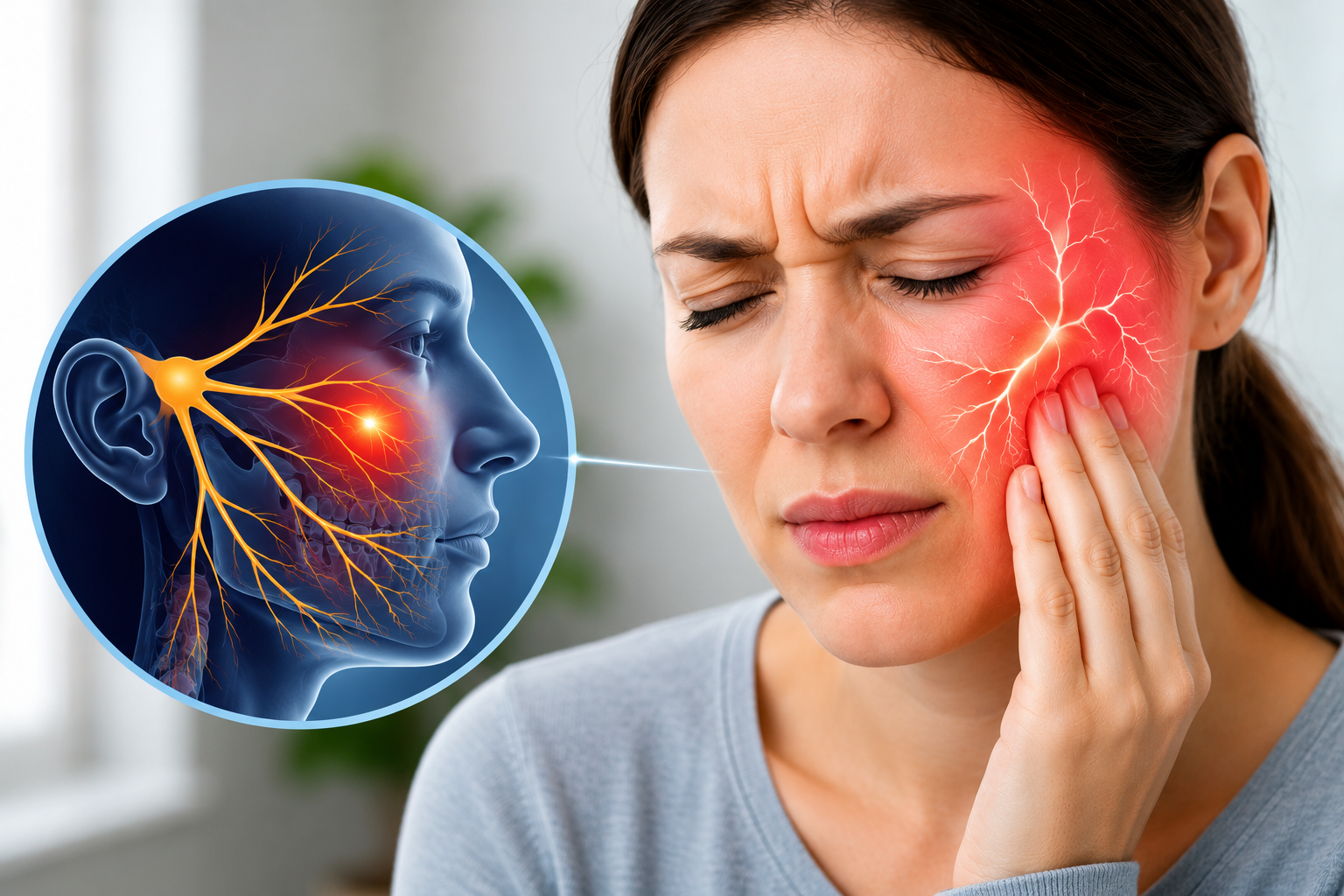
The trigeminal nerve carries sensation from the face to the brain. It has branches that cover the forehead, cheek, upper jaw, lower jaw, and parts of the mouth.
When this nerve becomes irritated, trigeminal neuralgia can cause sudden, severe facial pain. People often describe the pain as stabbing, electric, shooting, or shock-like. The attack may last only seconds, but it can repeat many times.
Small triggers can set off big pain
One of the most frustrating parts of trigeminal neuralgia is the mismatch between the trigger and the pain. Light touch, shaving, brushing teeth, washing the face, eating, talking, or a breeze against the skin may set off an attack.
That does not mean the person is overreacting. It means the nerve may be firing in a painful way from a very small signal.
The pain often affects one side of the face. It may sit in the cheek, jaw, teeth, gums, lips, or around the nose. Because it can feel like dental pain, some people see several dental providers before a nerve diagnosis becomes part of the conversation.
Hemifacial spasm usually feels like movement, not pain
Hemifacial spasm involves involuntary movement on one side of the face. It often begins around one eye. The eyelid may twitch, pull, or close without the person trying to move it. Over time, the twitching may spread to the cheek, mouth, or chin on the same side.
A person researching what a hemifacial spasm is may already know the symptom feels different from a simple eyelid twitch. The movement may be stronger, more frequent, or harder to ignore.
The twitch may spread across one side
A simple eyelid twitch often comes and goes, especially during stress, fatigue, or high caffeine use. Hemifacial spasm tends to follow a more one-sided pattern. It may start near the eye, then involve the lower face.
Some people notice the eye squeezing shut. Others notice the mouth pulling to one side. The movement can happen during conversation, while eating, or even during sleep.
The symptom may not be painful, but it can still disrupt daily life. Reading, driving, speaking, eating, and social contact can all become harder when facial movement is unpredictable.
How to tell pain symptoms from movement symptoms
The distinction between trigeminal neuralgia and hemifacial spasm often starts with one question: is the main symptom pain or movement?
Trigeminal neuralgia is usually a facial pain condition. Hemifacial spasm is usually a facial movement condition. Both can involve cranial nerves, but they do not affect the face in the same way.
Ask what the symptom does
Try to describe the symptom without naming a diagnosis first.
Does it shoot, burn, stab, or shock? Does it last seconds and return in bursts? Does light touch trigger it? Does chewing or brushing teeth bring it on?
Or does the face move on its own? Does one eyelid close without effort? Does the cheek twitch? Does the mouth pull to one side?
These details can guide the next medical visit.
When facial symptoms need medical review
A mild eyelid twitch after poor sleep may not need urgent care. A brief ache after dental work may settle. The concern rises when symptoms repeat, spread, intensify, or follow a nerve-like pattern.
Schedule a medical visit when facial pain is severe, shock-like, one-sided, triggered by light touch, or recurring. It is also wise to seek care when twitching affects one side of the face, spreads beyond the eyelid, closes the eye, pulls the mouth, or interferes with speaking, eating, reading, or driving.
Seek urgent care for sudden facial drooping, trouble speaking, arm or leg weakness, confusion, sudden vision changes, the worst headache of your life, fever with stiff neck, or new neurological symptoms. Those signs need prompt evaluation because they can point to conditions beyond facial nerve irritation.
Why diagnosis may take more than one visit
Facial symptoms can pass through several clinics before the source is clear. A person may begin with a dentist, primary care doctor, eye doctor, or urgent care office. That path is common because symptoms overlap.
A clinician may ask about timing, triggers, side of the face, dental history, infections, prior facial weakness, headaches, hearing changes, balance problems, and medications. A neurological exam may check facial sensation, muscle movement, reflexes, eye closure, jaw strength, and coordination.
Imaging may be ordered when the pattern suggests nerve compression, structural causes, tumors, multiple sclerosis, or another condition that needs a closer look. Not every person needs the same tests.
Treatment depends on the nerve involved
Treatment for facial pain and twitching is not one-size-fits-all. Trigeminal neuralgia and hemifacial spasm often require different approaches.
For trigeminal neuralgia, clinicians may use medications that calm nerve firing. Some people need imaging or surgical consultation when medication does not control attacks or side effects become difficult.
For hemifacial spasm, treatment may include botulinum toxin injections to quiet the overactive facial muscles. In selected cases, surgery may be discussed when a blood vessel is pressing on the facial nerve and symptoms remain severe.
The best next step depends on the diagnosis, symptom pattern, exam findings, health history, and how much the symptoms affect daily life.
What to track before the appointment
A short symptom record can make the visit more useful. Keep it simple and factual.
Track:
l Which side of the face is affected
l Whether the main symptom is pain, twitching, numbness, or pulling
l How long each episode lasts
l What seems to trigger it
l Whether it happens during sleep
l Whether chewing, brushing teeth, talking, or touching the face sets it off
l Any hearing changes, dizziness, headaches, facial weakness, or vision changes
l Any dental work, infections, injuries, or prior facial paralysis
Patterns that seem small at home may be the details that help the clinician separate dental, jaw, sinus, nerve, and muscle causes.
FAQ
Can trigeminal neuralgia feel like a tooth problem?
Yes. Trigeminal neuralgia can cause severe pain in the jaw, teeth, gums, cheek, or lips. Because of that, some people first think they have a dental problem. Recurring shock-like pain triggered by light touch or chewing should raise the possibility of a nerve source.
Is hemifacial spasm the same as an eye twitch?
Not usually. A simple eyelid twitch is common and may be tied to fatigue, stress, caffeine, or eye strain. Hemifacial spasm tends to affect one side of the face and may spread from the eye to the cheek or mouth.
Can stress cause facial twitching?
Stress and fatigue can make twitching more noticeable, but repeated one-sided facial spasms should not be blamed on stress without an exam. A healthcare professional can check for nerve-related causes.
Which doctor treats facial nerve symptoms?
Many people start with primary care, dentistry, or eye care, depending on the symptom. A neurologist or neurosurgeon may become involved when the pattern suggests trigeminal neuralgia, hemifacial spasm, nerve compression, or another neurological condition.
Key Takeaway
Facial pain and twitching can look minor at first, but the pattern can reveal more than the symptom label. Sudden electric facial pain points in a different direction than one-sided twitching that spreads from the eye to the mouth. Track what happens, what triggers it, and which side of the face is involved. Those details can help the right provider decide whether the next step should be dental care, primary care, neurology, imaging, or symptom-focused treatment.
Sources
Common Medical Questions: Trigeminal Neuralgia Symptoms
Common Medical Questions: What is a Hemifacial Spasm?
Verywell Health: Trigeminal Neuralgia and How It Is Treated
Verywell Health: What Is Hemifacial Spasm and How Is It Treated?
Washington Post: Medical Mysteries, Hemifacial Spasm Case